

LABash 2026 recently convened at The Ohio State University (TOSU). This year’s theme, “Cross-Pollinate,” reflected what materialized in real life—landscape architects exchanging ideas, listening as much as they talked, and experiencing the city of Columbus and The Ohio State University as living classrooms for their craft.
Here are 8 highlights from the event:
1. Celebrating creativity: 1,000 Trees Gallery + The Ramp Up Awards
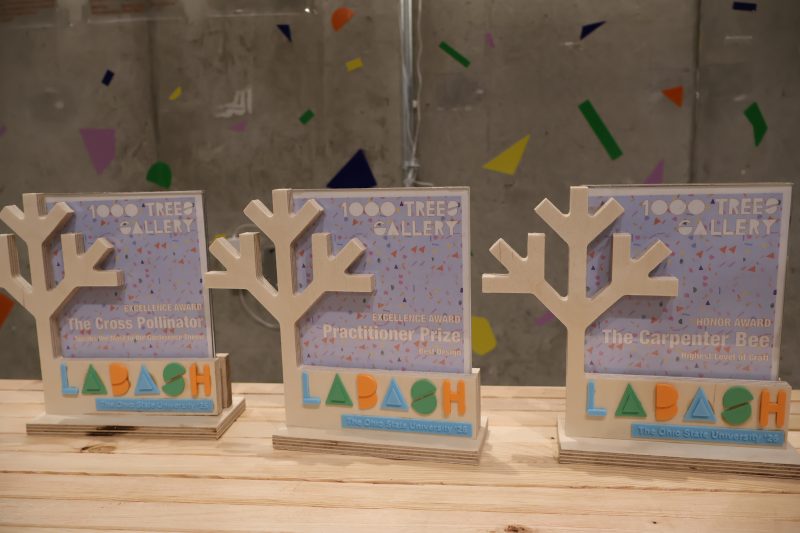
Leading up to the conference, event organizers invited participants, students, artists, and other landscape architecture enthusiasts to build a “forest unlike any other.” The 1,000 Trees Gallery consisted of crafted model trees, each made by a different artist, which all came together as a shared installation. The exhibit reminded us that our field is built from individual perspectives and the fact that materials grow stronger when they work together.
And then there’s the Ramp Up Awards. In partnership with The Knowlton School, LABash challenged TOSU students to display their favorite project proposals, redesigns, and other work. The LABash crowd voted over the course of the conference, and the winners were announced on the final day.
This un-curated, informal event celebrated student work at Knowlton and provided a space where we could cheer one another on. Whether participants were presenting, attending, or just trying to figure out how others make their diagrams look so clean, the event had that festive, awards-night feeling of unity and community.
2. Networking (“cross-pollination”) that didn’t feel forced
Forming new connections is a big reason to attend any conference, and LABash 2026 delivered. The theme, “cross-pollination,” built positive human interaction into every aspect of the event. Participants met in sessions, at the Expo, through informal conversations over lunch, and during celebratory events to exchange wisdom, seed new projects, and form new connections. This is LABash’s superpower: it’s student-led, so it naturally prioritizes peer-to-peer connection.
3. Showing career paths beyond traditional studio jobs
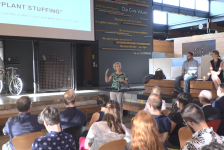
A clear theme emerged throughout our conversations at LABash: Landscape architects can apply their skills to a range of roles. We saw this reflected in the educational sessions, which included topics such as planning your career with intention, navigating your first years on the job, and unexpected career paths for landscape architects.
LABash provided opportunities to learn about career possibilities that extend beyond the classic “design studio” path — work that intersects with policy, advocacy, research, fabrication, ecology, and community partnerships. For emerging professionals, it’s comforting and motivating to see how this degree can take its recipients down many paths toward seeding safe and resilient communities.
4. Student leadership!
It’s easy to forget how much effort goes into LABash until you see it in action. LABash is “led by students, for students,” and TOSU’s team met that challenge. From logistics to programming to the overall tone, you could see student leadership in action: problem-solving on the fly, welcoming attendees, and keeping the schedule moving.
We also loved seeing the TOSU team pass the Permaloc Cup to next year’s team at Arizona State University and can’t wait to see how they build on this year’s experience.
5. Wisdom from seasoned voices (without the lecture-y vibe)
“Cross-pollination” also means mixing generations. ASLA President Brad McCauley, FASLA, PLA, reminded us why landscape architects are uniquely suited to address key social and climate justice challenges. Keynote speaker, Julia Watson, author of the ground-breaking books, Lo—TEK: Design by Radical Indigenism and Lo—TEK Water: A Field Guide for TEKnolog, explained how Indigenous, nature-based approaches to landscape design can help address the consequences of our changing climate. Her speech highlighted how Indigenous innovations like floating farms, tidal fish traps, and aquifer recharge systems can help shape resilient cities and landscapes. Her message resonated. Following her session, students lined up to talk with her more.
6. Real support
The Expo floor buzzed with activity, and exhibitors provided a clear window into the profession. About 35 companies, firms, universities, and non-profits showed up to engage with students. You could see the effect in the interactions: students felt empowered to step into conversations, ask honest questions, and collect cool swag.
Day two culminated with a party hosted by Green Theory, full of camaraderie, beats, and epic bonding. The next night, Permaloc capped the whole experience off with a final celebration where a stunning sunset provided the backdrop for toasts, drinks, and dancing. It was a late night, and yes, we may have been knocking back coffee the entire next day, but it was worth it, and knowing us, we’ll do it again next year.
7. Hospitality that made the hectic feel manageable
Here’s something people don’t say enough: Conferences are expensive and tiring. So, when hospitality is done well, it matters.
LABash and TOSU clearly understood the assignment. Small touches such as food trucks, free meals, and shuttle service felt like a steady hand on our shoulder. Shout out to Buckeye Donuts! They kept us fueled, present, and ready to go.
8. Landscape architecture in action: TOSU and Columbus as the classroom
TOSU’s campus also played an active role in the experience. From its open lawns to its tree-lined paths and evolving spaces, TOSU and LABash offered participants the opportunity to experience ideas “in a setting that embodies them.” Many field sessions, such as the excursion to the Ohio Zoo, took place off campus, letting Columbus and its public spaces serve as teachers in their own right.
The takeaway
LABash at TOSU carried a simple message: This profession is bigger than studios or job titles. The field is buzzing with experienced professionals happy to lend their advice and experiences to blooming landscape architects.
We came for the sessions, the gallery, and the Expo. We left with new connections and a clearer sense of our place in landscape architecture.
Published in Blog, Cover Story