

By Leah Romero with Dr. Suzanne Quinn
Across parks, schools, and neighborhoods, communities are asking for outdoor spaces that do more than satisfy a minimum standard. They want places that enrich daily life, support well-being, and reflect sustainable values. More and more municipalities are now requesting or even requiring that every new playground or park include elements of nature play, reflecting a growing recognition of its benefits for children and communities.
But what is nature play? While it does not yet have an official definition, at KOMPAN, we think of it as an approach to play space design that merges best practices and standards from traditional play environments with the psychological and developmental benefits of immersion in the natural world.
For landscape architects, this is an opportunity to lead. Nature play isn’t just a design option; it’s a professional responsibility. Research shows that spending time in nature is associated with a host of beneficial physiological, psychological, social, and developmental outcomes. By integrating natural elements into play environments, we can deliver spaces that spark children’s creativity, strengthen their health, and foster deeper community connections. Nature play represents the kind of forward-looking design leadership that clients increasingly expect, and communities truly need.
As landscape architects, we are uniquely positioned to guide clients toward choices that balance creativity, sustainability, and community impact. Nature play demonstrates the value of that leadership. It shifts the conversation from purchasing equipment to creating meaningful, site-specific experiences that serve both children and the broader public. By championing nature play, we model evidence-based practice, elevate the profession’s role in shaping healthier communities, and show clients how design can deliver long-term social and ecological benefits.
Play is more than recreation; it is an adaptive survival behavior. Nature play environments provide additional child development opportunities, such as loose parts play and fine motor skill development, that are difficult to provide with manufactured elements. Naturalized playgrounds and hands-on experiences with nature support children’s growth and development across all domains. Equally important, time in natural settings reduces stress, supports mental health, and nurtures social interaction. Unstructured time in nature, time that is not work-based, is essential for healthy child development. Many children are drawn to the natural environment as it provides endless opportunities for adventure, exploration, and wonder. This fascination can support ecological behaviors that are essential to nurture in the coming generations.
It is sometimes assumed that simply using native materials provides the benefits of nature play. However, creating play equipment from non-standard elements poses safety risks not sanctioned by American playground safety standards, and native materials alone do not guarantee the same developmental outcomes. A more effective approach is to use manufactured play equipment thoughtfully integrated into natural and naturalized areas. This taps into the full potential of both manufactured and nature-based play. When considered early in the design process, equipment choices can be woven seamlessly into the surrounding landscape. Thoughtful integration allows manufactured elements to complement natural features, creating play environments that are both safe and inspiring. This kind of integration is exactly where landscape architects can lead.
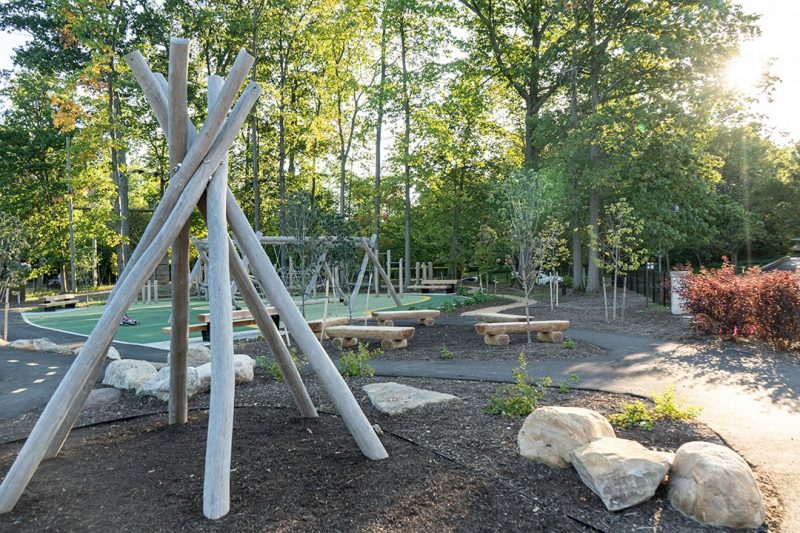
The KOMPAN Play Institute, in partnership with the City of Kettering, Ohio, examined the use of a newly designed nature park and playground by interviewing and observing adult and child playground patrons. The naturalized playground is designed with the topography of the park space, with embankment slides and zip lines that support play at the different elevations. A generous number of swings are placed throughout the playground space, and much of the equipment in the space is made of Robinia hard wood (Black Locust). Park patrons explained that the environment was both thrilling and relaxing and gave them a pleasant experience compared to the often excited or chaotic environment of a traditional playground on a smaller footprint.
Nature play is also about equity. For many historically disenfranchised communities, the local playground may be the only accessible place to experience nature. By integrating plants, especially native species, into play environments, landscape architects can provide vital exposure to green space while also restoring pre-colonial ecologies. Native plantings not only support children’s sensory exploration but also create habitats that invite wildlife interactions, which can support children’s healthy growth, development, and knowledge. These encounters inspire lasting environmental awareness. In the Anthropocene, even small design choices, such as planting a single native tree or shrub, carry outsized importance. Our duty as designers is not only to shape play but also to repair and sustain the land we steward, ensuring that every community has the chance to benefit from meaningful connections with nature.
For landscape architects, nature play is an invitation to lead with purpose. By bringing clients into conversation about how play environments can nurture children and strengthen communities, we demonstrate the highest value of our profession. The spaces we design today will shape how future generations learn, grow, and connect to the natural world. Nature play is not just a playground. It’s a vision for happier and healthier communities.
Published in Blog, Featured