

By Jill Moore, inclusive play specialist, Landscape Structures Inc.
When I roll into a new park, one of the first things I notice is whether inclusion ends at the ramp or if it extends to the entire space. Too often, I see beautiful playstructures that “meet the code,” but don’t truly invite everyone to participate. As a wheelchair user, going to the playground as a child frequently meant I was relegated to the sidelines. Now, as an inclusive play specialist and an advocate within the space, I get to see firsthand the impact of creating playgrounds that go beyond minimum requirements. The law sets the floor. As designers, planners, and advocates, we can reach for the ceiling.
That perspective isn’t new at Landscape Structures. Back in 1993, our Cofounder Steve King, was appointed to the Federal Access Board’s Recreation Access Advisory Committee. That moment launched our quest to go beyond compliance and start creating play spaces that welcome everyone. From the beginning, we sought input from people with lived experiences of disability. Their insights gave us something far more valuable than well-meaning guesses: practical knowledge about how spaces feel and function.
Over the years, we’ve broadened the circle of experts who guide our work. Today, our thought leaders represent a wide range of experiences: mobility disabilities, visual and hearing disabilities, autism, ADHD, colorblindness, and medically complex diagnoses, among others. These voices include employees, therapists, parents, academics, and, most importantly, the kids who use our equipment.
Their input helps us create what’s next in inclusive play. It informs the balance between physical challenges and social opportunities. It inspires us to think intentionally about sensory play, perceived risk, and even the aesthetics of a playground so that kids of all abilities can build courage and confidence while having fun.
If you’ve spent time in the disability advocacy space, you’ve probably heard the phrase “Nothing About Us Without Us.” For playground design, it should be your guiding principle.
When designing a play space, the best way to know how the community will use the playground is to ask them. Invite kids with disabilities, their families and caregivers, and local experts such as special educators and occupational or physical therapists into the design process. Their feedback will reveal details you may never think about on your own, like how a transfer point feels for a child moving from their mobility device, or how colors might affect kids who have a visual disability.
And don’t stop after the first meeting. When you include people with disabilities throughout the project, you’ll ensure their needs are met in everyday matters.
Once you’ve gathered input, the fun of putting those insights into action begins. An inclusive playground should offer a strategic balance of physical, sensory, cognitive, and social experiences:
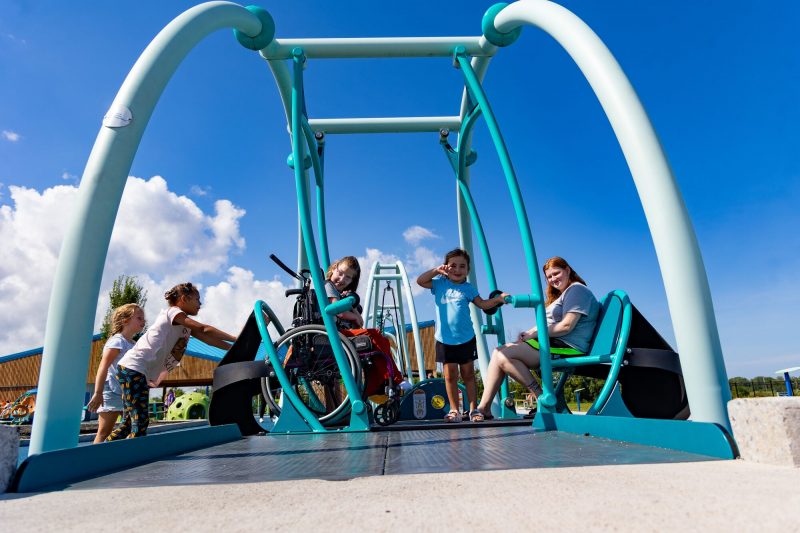
- Movement: Swinging, spinning, and sliding are classic activities that help children regulate their emotions and develop balance and body awareness. The key is offering a range of options so kids can choose the thrill and sensory feedback that feels right for them.
- Social play: Select equipment that all children can use together, whether in a mobility device or walking. Not every child thrives in a big group. Provide cozy nooks for quiet play alongside larger gathering spaces for parallel or cooperative play.
- Sensory variety: Incorporate elements like sand, water, textured panels, flowers, and plants. These multisensory features help kids regulate their systems and connect with their environment.
- Variability: The strongest measurement of play value is options. Multiple ways to climb, slide, or spin mean kids can test their abilities, find success, and build new skills at their own pace.
One of my favorite things to see is how universal design enhances not just accessibility, but fun. A well-placed ramp isn’t just for wheelchairs; it’s also a runway for toddlers finding their balance or grandparents who want to stay close to their grandkids. Good design benefits everyone.
Inclusive play doesn’t end at the edge of the playground structure. The entire park matters.
Think about the journey from parking lot to play area. Are pathways wide and smooth enough for wheeled devices and strollers? Is wayfinding clear for people with visual or auditory disabilities, or those who use communication devices?
Shade is another important detail to consider. Due to level of injury or medication, people with disabilities are often at higher risk for heat-related illness, so shaded play and seating areas are essential. The same goes for restrooms. If a parent can’t find an accessible restroom with a universal changing table, their family won’t stay long—no matter how amazing the playground is.
Splash pads, picnic areas, fencing, seating, and bus drop-off zones—all of these features contribute to whether a play space feels welcoming. Inclusivity is not confined to the equipment. It’s about the entire experience of being there.
At the end of the day, inclusion is about autonomy. Kids should be able to choose how they engage with a play space. Per the social model of disability, the built environment defines who’s invited to play and how they can succeed, and every child needs the ability to engage in meaningful play. When children can say, “I want to swing fast,” or “I’d rather climb slowly,” they gain confidence and independence. And when caregivers and grandparents can join in or comfortably supervise, we’ve created a space that everyone can use together.
As designers and landscape architects, your role is to create spaces that honor those choices. That means thinking holistically, listening carefully, and designing with—not just for—the people who will use your spaces.
Our journey to inclusion wasn’t linear, and it isn’t over. We’re constantly learning and looking for more meaningful ways to design play spaces that benefit everyone. Every playground project has become an opportunity to do better and to smartly push the boundaries of what an inclusive play space can be. We learn from experts in this space every single day, and it’s exciting that inclusion is a journey that continues to evolve.
When you design with the whole play space in mind, you’re not just creating a playground. You’re creating belonging. And that’s the kind of legacy every community deserves.
Sponsored Content
Published in Blog, Featured, Parks and Recreation, Products, Specify Products