

What changes on the National Mall say about preservation vs renovation
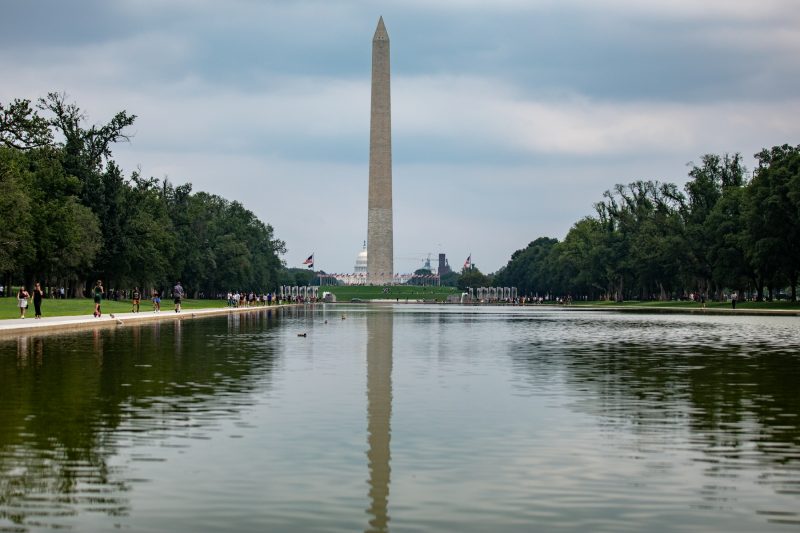
The Reflecting Pool “is one of the most iconic structures in the United States, and is an integral part of ‘one of the important axes in the nation, one that aligns several key national symbols including the U.S. Capitol Building, the Washington Monument, the World War II Memorial, and the Lincoln Memorial,‘” according to a complaint filed by The Cultural Landscape Foundation (TCLF).
TCLF has sued the U.S. Department of the Interior, claiming the current application of blue paint to the basin of the Reflecting Pool is being done in violation of federal law. The Reflecting Pool holds profound historic significance, serving as the staging area for marches on Washington, the Pentagon, and many inaugurations.
Today, the pool is a cherished public space, where Washingtonians bike, walk, and live. They mingle with tourists as practical infrastructure and cultural heritage intersect. The pool reflects, frames, and connects. That’s why, in part, the recent renovation is controversial.
According to recent pieces in The New York Times, the Trump administration awarded a no-bid contract to Atlantic Industrial Coatings to resurface the Reflecting Pool and apply a blue waterproof coating. They initially said the work would cost about $1.8 million. Days later, the projected cost rose to $13.1 million. The administration said the increase reflected plans to accelerate the job ahead of the nation’s 250th birthday this year. Officials also used an emergency rationale to bypass competitive bidding, saying delay could cause “serious injury” to the government, though that explanation has remained vague, as summarized by Raw Story.
For landscape architects and preservation advocates, the concern is not simply cost, or even color. It is what this episode reveals about how public landscapes are appreciated and preserved.
As reported by NPR, TCLF’s Charles Birnbaum warned that the pool should not be viewed in isolation, but as part of the overall design of the National Mall. That distinction matters. In landscape architecture, context is not decorative; it means something.
Too often, a high-profile landscape is treated as a cosmetic problem: scrub, seal, brighten, move on. But the Reflecting Pool is a historic work of civic design, one whose meaning depends on proportion, materials, and intent. A landscape like this cannot be reduced to whether it looks cleaner on camera or brighter for a national celebration.
To be fair, the Reflecting Pool has had real maintenance issues for years. Leakage, algae, and filtration problems are real concerns. Public officials are right to want the space to function well, especially at a site visited by millions. Cheap fixes are tempting, but speed and visibility are not necessarily stewardship.
This story exposes a familiar tension in public landscape work: the difference between managing a space and understanding it. A pool contractor knows coatings, waterproofing, and schedules. A preservationist asks different questions: What’s the visual intent of the original design? How do materials alter the spatial experience? What happens when a reflective ground plane becomes a designed color field? What kind of pool is this?
Published in Blog, Cover Story, News